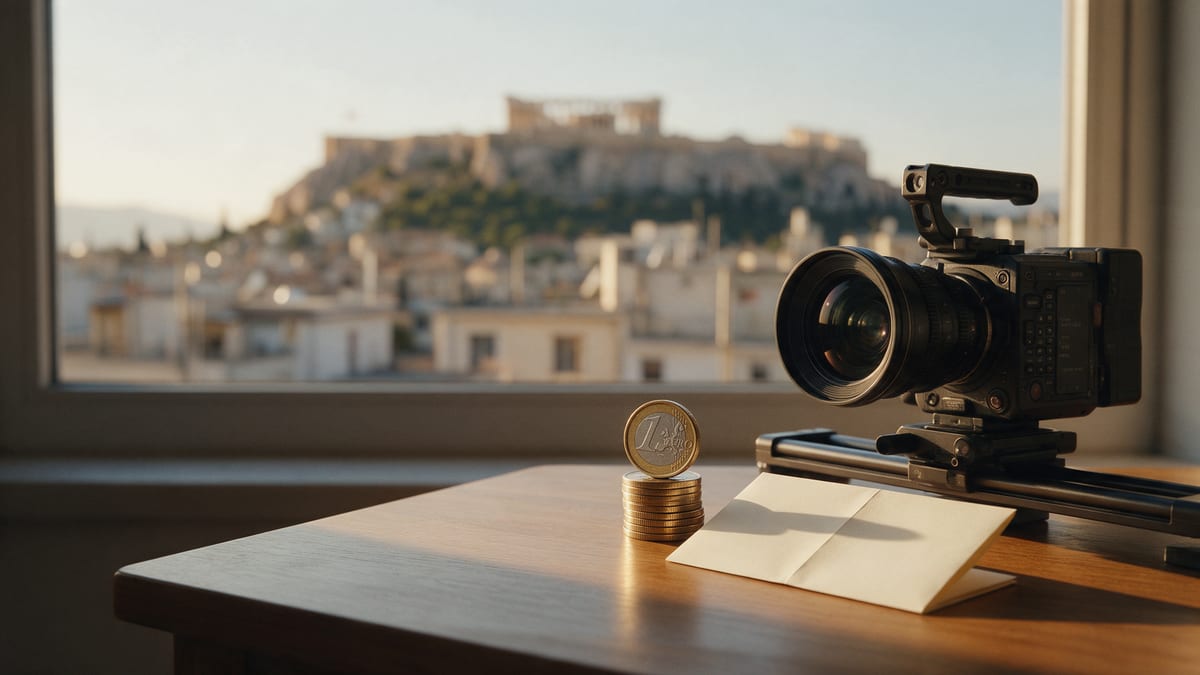
“How much for a video?” is the most common first message I get. It usually arrives with no brief at all.
I understand why. If you have never commissioned a video, you have nothing to compare it to. But it is a bit like asking what a building costs before saying whether it is a garden shed or an office block. The honest answer is “it depends”, and that answer is useless when you are trying to set a budget.
So here is the version I wish more clients could read before they write to me: what actually drives video production cost in Greece, the ranges I work in (in euros), and what a quote does and does not include. I have been doing this for 20 years, and I have never seen another Greek videographer publish real numbers. Let’s fix that.
Start with the question behind the price
When someone asks for a price with almost no information, I ask three things first:
- What is the video for?
- How long does it need to be?
- Is there a reference video you saw and liked?
That is enough for a first read. The purpose tells me the approach and the budget tier: a commercial and a personal project are built very differently, even when they run the same length. The length tells me how much footage and editing I am looking at. And the reference tells me the tone and style you have in mind, and what “good” looks like in your head, which is where most budget gaps hide.
After that, ideally, we have a short call about the rest: when you need it, where we would film, for how many days, and anything special. A promo may need actors. A corporate video where people speak to camera may need a teleprompter. Each of those changes the crew, and the crew changes the price. Once I have it all, I work out how many people I need and in what roles, and only then do I write the offer.
What actually drives the cost
Almost every quote is built from the same handful of things.
Shoot days. Days on location, plus any pre-production day to plan, scout and prepare. Shooting hours on a normal day run up to 8.
Crew size. A small job can be done by one or two people. A bigger one needs a director, camera operators, a sound recordist and assistants. A larger company that has commissioned video before usually knows this and budgets for it.
Equipment. A single camera is one thing. Multi-camera setups, a drone, lighting and sound gear are another, and each adds cost.
Post-production. Editing is where time hides. A simple cut is one thing; a dedicated colour grading session, motion graphics, sound mix and subtitles are another. I estimate editing per project, based on how many hours I think it will take.
Versions and languages. A 60-second cut, a 15-second cut for social and a version in a second language are three deliverables, not one.
Usage rights. More on that below, because it surprises people.
None of these is a trick. Together they explain why the same brief can produce very different quotes from different companies.
Typical ranges in euros
These are the ranges I publish on my site, and they are starting points, not promises.
Event coverage: from €500. This usually means a small event filmed by one videographer, who also edits it. It does not include a sound recordist, a second camera, specialised colour grading or anything more advanced. Shooting is up to 8 hours in a day. A bigger event, more cameras or a faster turnaround moves the price up from there.
Corporate videos: €1,000 to €10,000. The spread is wide for a reason. At the low end, think of a one or two person crew doing interviews in an office, or a straightforward shoot with light editing. At the top, think of a recent corporate job of mine with a four-person crew, a pre-production day, full editing and a dedicated colour grading session. Same category, very different workload.
Documentary or commercial productions: €5,000 to €20,000+. Multiple shoot days, a larger crew, better equipment, serious post-production. The ”+” is honest; some projects go well beyond.
AI video: €150 to €1,500 for most projects. A simple 30-second social clip sits near the bottom. But “most projects” matters. A recent job of mine is an AI short film of 8 to 10 minutes, where the client wants to previsualise a written script before deciding whether to film it properly. Consistency between characters and scenes, plus the look, means a huge number of generations and different strategies to get there. That kind of project is priced far above €1,500.
And here is the part the AI hype tends to skip: AI video is cheaper than shooting the same thing for real, but it is not automatically cheaper than a simple, well-planned conventional shoot. If you then wanted to film what the AI version showed, expect that to cost three, four, maybe five times more. A complex, high-end AI result can cost more than a modest live-action production.
If your project is an AI one, the AI video cost calculator gives you a rough estimate in a couple of minutes, before we ever talk.
Footage, a finished film, or both
One thing I do often: quote the scope as separate options. Some clients only need the raw footage (a company with its own editor, say). Some want an edited film. Some want both. I have done shoots where I simply delivered the footage with no editing at all, and the price reflected that.
Pricing these separately means you choose the scope, instead of paying for work you do not need.
Revisions: where budgets quietly leak
I typically include one revision round. Additional rounds are an optional add-on.
Why spell this out? Because the only time a project reliably takes longer than planned is editing, when feedback keeps coming or opinions change from cut to cut. If revisions are not stated in the offer, I have to take the hit and keep going until you are happy. That is on me for not writing it down. A long-running client with whom I have years of trust is a different relationship from someone new, but for a first project, clear terms protect both sides.
Who owns the video, and what you can do with it
Many people assume “the video is mine once I pay”. It is a little more nuanced.
Using the video on your own channels is included: your website, your social media, internal use and event screenings. Paid advertising, broadcast, or buying the rights outright are quoted separately.
The logic is simple. A video for an event recap or an internal presentation supports your business. A video built to run as an ad is expected to earn money for you, so the production is priced with that in mind. If you tell me upfront where it will run, there are no surprises.
VAT, deposits and how payment works
VAT. Greek businesses and private individuals pay 24% VAT on top of the quote. Businesses in other EU countries and outside the EU are invoiced without Greek VAT.
Deposit. A 50% deposit confirms the booking, and the balance is due before final delivery.
How to pay. Bank transfer in euros, Revolut or Wise.
What to send for a quote, and what happens next
You do not need a polished brief. Send me:
- The purpose of the video.
- The approximate duration.
- A reference video that feels close to what you imagine.
- When you need it, where it would be filmed and for how many days, if you know.
From that I can see quickly whether your budget and your needs line up. A quote comes within two working days of the brief.
When the budget is smaller than the brief
This happens, and there are really two kinds of clients.
Some have a vision and no fixed number. They are open to whatever the honest cost is. Others say they have no budget, but in reality there is a maximum they will not go past. Sometimes that matches what they want. Sometimes it does not. I have seen clients picture a project of a few thousand euros with €500 to spend, or less.
If we are talking, I explain why it costs what it does, and if there is a version that works with compromises, I list those compromises clearly and we adjust until you are comfortable. The worst case is when a client reads the quote and goes silent; then there is nothing I can offer, because I never find out what the real limit was. So tell me your range. It saves both of us time.
And if the gap is simply too big, I will say so. Then I would tell you to go and ask around the market. Someone may do it for what you have.
For the same brief, you can get three completely different offers. The difference is experience, professionalism and track record, and that experience is what gets you out of trouble when the unexpected happens.
A videographer just starting out may happily work for almost nothing to build a portfolio. A company with years behind it prices the experience, because experience is what saves your shoot when the weather turns, the location falls through or the interview runs long. Neither is wrong. They are different products, and often you see the difference in the final result. Budget cuts show up on screen.
Get a number you can plan with
If you have read this far, you already know more about video production cost in Greece than most people who ask me for a price. So, a last question: what would you want the video to do for you in a year? Start there, and the budget usually follows.
When you are ready, send me the purpose, the length and a reference, using the contact page. You will have a quote within two working days. You can also see what I do on the video production services page, or read more about my background first.