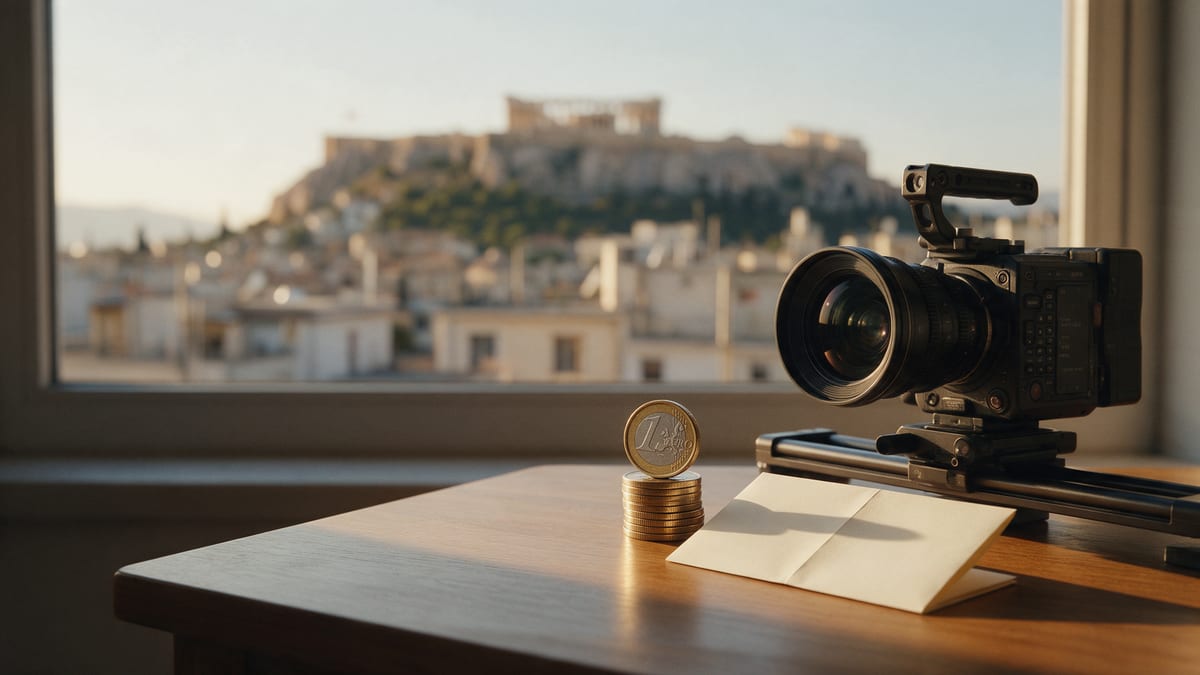
Every few months someone writes to me with the same plan: “We land Thursday, we want the Acropolis in the opening shot, can you sort the permit by Friday?” I understand the instinct. It is the most filmed skyline in Europe, so surely there is a form and a fee and a stamp. There is. It just does not fit in a Friday.
This is the guide I wish I could forward to those emails. It covers when you need a filming permit in Athens, how the archaeological site process works, what you can shoot without one, and the basics of flying a drone legally. Rules change, so I link the official source for every claim and tell you where I could not confirm a detail.
The short version: what needs a permit and what doesn’t
Greece’s Ministry of Foreign Affairs states the general rule plainly: filming and photography in open public spaces are generally permitted without prior authorization, as long as you do not offend public decency or undermine public interest, and do not impede the normal flow of pedestrians or vehicles.
Special permits are required for places like archaeological sites, museums, monuments, airports, metro and train stations, hospitals, courts, universities, schools, places of worship, port and military facilities, and protected natural areas. Drones and underwater filming have their own permits.
So the dividing line is not “Athens vs. elsewhere”. It is whether the location is a protected or controlled place, and whether your crew blocks the public. Two street-level realities sit on top of that:
- A phone or a small camera on a walking shot is one thing. A tripod, lights, a crew of eight and a cordon is another, because it impedes the normal flow. That is where the municipality comes in.
- Private venues (a restaurant, a hotel, an office, a rooftop) are not in the Ministry’s list at all, because they are not a state matter. You need the owner’s written permission, and a good venue will ask for your insurance details. That permission covers the place, not a monument in your frame, which I come back to below.
I could not find an official Athens-wide rulebook for commercial street shoots. The City of Athens runs an Athens Film Office that helps productions with permits for occupying public space, so that is the first call for anything bigger than a handheld shot. Treat it as “ask early” rather than “assume no”.
Filming inside an archaeological site
This is the part that surprises people. The Ministry of Culture and Sports publishes instructions for filming at monuments, archaeological sites and museums, and it is refreshingly specific.
The application has to be submitted at least one month before you film, or the Central Archaeological Council will not assess it. What goes in the pack:
- The film scenario.
- A list and description of your equipment.
- A list of crew members.
- A declaration that you will follow the legislation and know the fees.
- An authorization letter, if someone applies on your behalf.
- For fiction films, a certificate from the Hellenic Film Commission confirming the script does not promote violence, racism or sexism.
Where you send it depends on the scope. One site or museum goes to the local Ephorate of Antiquities. UNESCO monuments, or more than one site, go to the Department of Archaeological Museums and Collections. For the Acropolis you are in UNESCO territory, so plan for the second route and a decision by the Minister.
What it costs
There are two kinds of charge, and people tend to remember only one of them.
Filming fees are paid before you shoot. The Ministry’s table lists the Acropolis and the monuments of its slopes, the Ancient Agora, Sounion, Delphi, Olympia and Knossos among the major sites. The fee is 200 euros + VAT per day and site without people on camera, and 1,600 euros + VAT per day and site when people are featured. Aerial filming is 800 euros + VAT per day.
User fees come after, based on what ends up on screen. The charge is per second of depiction of the site, and it scales with your total production cost:
One caveat from the same document: those fees are reduced by 50% when the film is primarily educational, scientific or cultural, or when it promotes Greece internationally as a tourist destination. Exemptions exist for licensed researchers, scientists working for educational purposes, and the Ministry’s own productions.
I will be honest about a limit here. The PDF carries no date, and other sources quote older or different figures. Before you put numbers in a budget, confirm the current schedule with the Ephorate. I also noticed that some guides describe the user fee “per minute”; the official document says per second, which is a very different invoice.
When you don’t have a month: the rooftop trap
The plan I hear most often on a tight schedule is “we’ll skip the site and film the Acropolis from a rooftop instead.” Moving the camera changes where you need permission to stand. It does not change the rule for the picture.
Greek law treats a recognisable image of a monument as something the state licenses. Article 46 of the antiquities code (Law 4858/2021) says that in every case, producing or reproducing images of monuments for distribution to the public with the aim of profit needs prior permission, against a fee paid to ODAP, the Ministry’s fund for archaeological proceeds. The article says nothing about where the camera stands. So a commercial, a brand film or a feature that shows the Parthenon from Lycabettus or from a Plaka rooftop is still using the image of the monument, and still needs the licence. The owner of the rooftop can let you onto the roof. Only the Ministry can license the view.
This is not a paperwork technicality. Using a monument’s image for profit without the licence can be prosecuted under Article 66 of the same law, and companies can face administrative fines on top.
The Ministry’s 2023 decision on filming and photographing monuments draws the one line that helps. Shots of the modern city, where monuments happen to sit inside the urban fabric, need no licence, as long as the shot does not focus on the monument and is not about it, directly or indirectly. A busy street in Monastiraki with the rock somewhere in the skyline is the city. A rooftop wide framed around the Parthenon is the Parthenon.
Purpose matters too, and this is where a non-profit film is in a very different place from a commercial. Without profit, the same Article 46 asks for prior permission only in specific cases: when access to the monument has special conditions, when you use complex or bulky equipment, for 3D scanning, or when the shoot affects security, opening hours or public access. A small crew on a private rooftop across the city triggers none of those. Educational and cultural films that do need a licence also pay half the fees.
A real example from my own work: for Vine Church, we filmed a speaker on a rooftop near Plaka, the city’s roofs below him and the Acropolis small on the hill behind. He opens by saying they are in Athens, with the Acropolis in the background, where the Apostle Paul preached. The film is educational, made with no profit in mind, for their YouTube channel. The speaker is the subject, the monument is the setting, the purpose is teaching, and nothing about the shoot touches the site. That is the kind of frame the rules leave free.
Put the same frame in a bank’s commercial and the answer changes. Now the Acropolis is helping to sell something, and that is the monument’s image used for profit: it needs the licence. The same goes for any film whose subject is the monument itself, like a documentary about the Parthenon.
So I ask three questions about every frame with a monument in it. Is it for profit? Is the monument the focus, or the subject of what is said? Does the shoot need anything at the site itself? If any answer is yes, or “maybe”, I put the question to the Ministry before the shoot.
The rooftop owner can let you onto the roof. Only the Ministry can license the view.
So on a short schedule you have two honest options:
- Apply for the image licence anyway. If the monument carries the shot, the application still goes to the Ministry, with the same one-month lead time. Filming from outside saves you the on-site logistics, not the permission.
- Make the city the subject. Choose angles where Athens is the story and the monument is part of the skyline, not the point of the frame. Lycabettus Hill, rooftops in Plaka, Monastiraki and Thissio, and neighbourhood streets all work, with the owner’s permission on private property and a small crew in public space.
Where “part of the skyline” ends and “focus on the monument” begins is a judgement call, and the Ministry makes it, not you. When the monument is doing the storytelling, I ask before we film, not after the edit.
Speaking of light: go early. Sunrise gives you softer, warmer light, a cleaner sky and far fewer visitors in frame. By mid-morning the heat and the crowds are both working against you.
Flying a drone legally
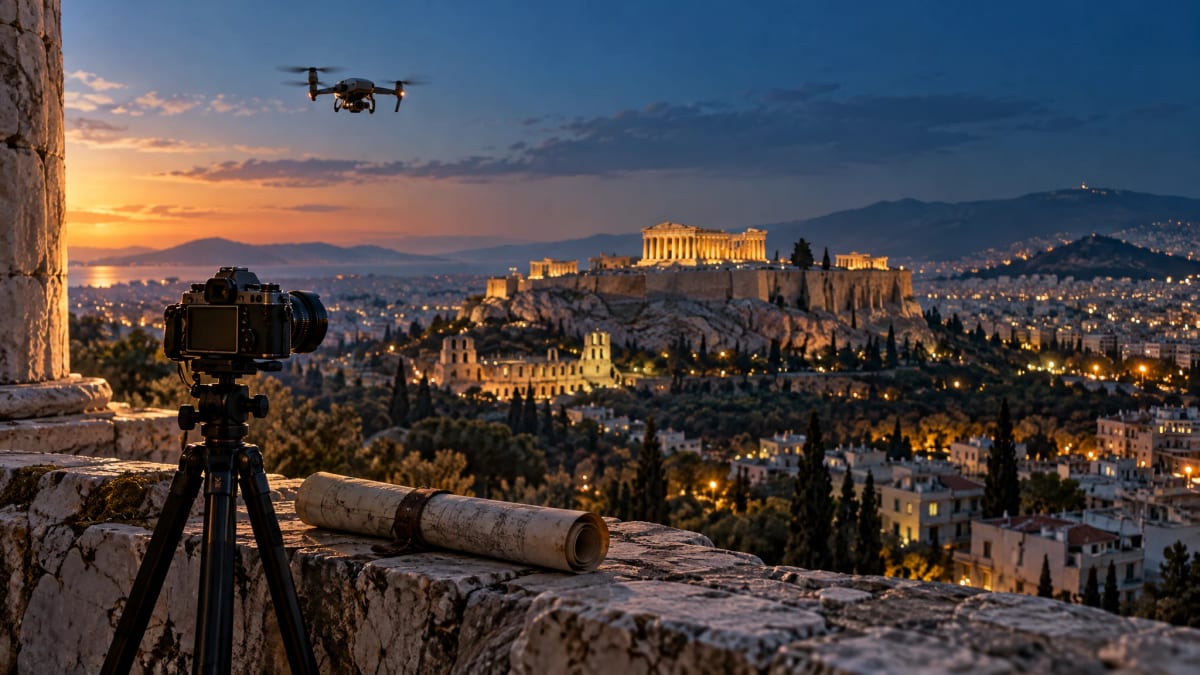
Drones are where I would be most careful, because the penalty for a wrong guess is worse than a wasted shoot day. What I could confirm from the Hellenic Civil Aviation Authority (HCAA):
- Check the airspace first. Before any flight in Greece, the HCAA says you must check restrictions on the DAGR (Drone Aware Greece) platform.
- Open category rules apply outside restricted zones. These are the EU-wide EASA rules, including the 120 metre height limit.
- Registration. If you are not registered as a UAS operator in another EASA member state, you register in Greece before flying. If you already are, no additional registration is required.
- Yellow and magenta zones, such as airports and archaeological sites, need prior approval in most cases. Flights may be permitted under conditions or prohibited outright.
- Critical sites such as ports, hospitals, archaeological sites and military or government installations are off limits without prior HCAA authorization.
- Lead time. The HCAA describes a flight notification form to be submitted at least 5 working days before the flight. When I checked, that form was marked closed to new submissions, so confirm the current procedure with the HCAA directly.
For professional work, the Hellenic Film Commission’s permits page adds that filming with a drone for professional purposes needs a commercial operation licence from the HCAA, and that aerial shots over archaeological monuments and historical sites carry the Ministry’s 800 euros + VAT per day fee.
A drone over an archaeological site can mean two authorities, two applications and two fees.
That last line is my reading of the two sources together (the HCAA for the flight, the Ministry for the site), not a sentence from either of them. It is also why I never promise a client an aerial of the Acropolis on short notice.
How I handle it on a shoot
After 20 years in production, the permit is never a surprise because it is a line in the pre-production plan, right next to casting and equipment. For each location I note three things: who owns or controls it, what the rules say, and what the fallback is if the answer is no or “too late”.
That last one matters most. If the Acropolis permit lands, great. If it doesn’t, there is already a version of the scene where the city is the subject, and nobody is panicking at sunrise. I also build the schedule so that the permit-dependent shots are not the ones holding the whole film hostage.
If you want to see what that looks like on a real project, my video production services page covers how I plan shoots, and who I am explains where this experience comes from.
Start the conversation before you land
A month sounds long until you count scenario approval, the crew list, payment and the Council’s schedule. For any location that needs a permit, the honest answer to “how soon?” is “earlier than you think”.
If your production is heading to Athens, or anywhere in Greece, get in touch while the idea is still a rough list of locations. Which shot are you most worried about getting? That is usually the one to start with.