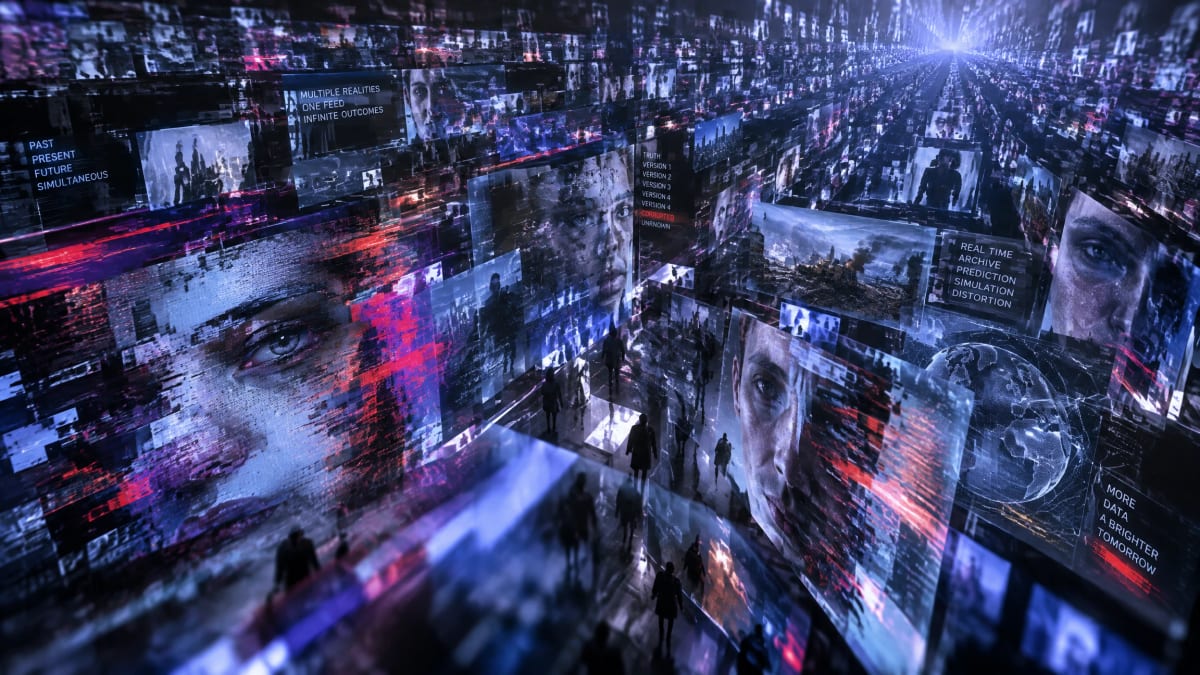
Open your phone right now and count how many things you would need to verify to fully trust your last ten minutes of scrolling. Ten videos? Fifteen headlines? A handful of confident claims from people you have never met?
Now be honest: how many did you check?
I’ll go first. Almost none. And I spend my days thinking about this stuff (I’m the guy who, after 20 years of documentaries, looks at every video and asks “is this real, or is this AI?” before I even register what it says). That instinct is now so wired into me that it fires automatically. But firing the question and actually chasing the answer are two very different things.
This article is not about my work, or my tools, or how I build things. It is about the world we all live in right now: an endless supply of information, no time to check any of it, and a brain that keeps asking for more. And it’s about what happens when you add the best language manipulator ever built into that mix.
The world of “I already know that”
Here’s the strange part of living in an age of abundant information. The information is out there. The source is usually one search away. Nothing is technically hidden.
And yet we don’t look.
Historically, the great mass of people has always been on the outside when it comes to what is really going on. Truth was whatever the power holders and policymakers decided to disclose, and everything else was rumor. That part isn’t new. What’s new is that today the masses perceive that knowledge is everywhere, and so they have a sense of knowing it all.
That sense is the dangerous part. Misinformation doesn’t need to hide anymore. It just needs to wear a cloak of perceived truth. When everything looks like information, the fake and the real sit side by side in the same feed, in the same font, with the same confident tone.
Why we can’t stop scrolling
I’m not going to pretend I’m immune. Doom scrolling looks similar on every platform. Facebook, Instagram, TikTok, it doesn’t matter; the content changes but the mechanism doesn’t. Once you are dragged in, it’s hard to stop, because the dopamine hit is right there. You want more, and more, and more, even when you are fully aware you are wasting your time watching nonsense. (Sometimes you do learn something. That’s exactly what keeps the loop alive.)
For me it’s YouTube. I sit down intending to watch one or two videos. Then the recommendations do their job, and suddenly I have a queue of 10 or 15 videos that all caught my attention and that I now “want” to watch. One topic leads to another topic, which leads to another, and it is endless unless I put a stop to it myself.
Look at what that does to verification. If I planned to watch two videos, I could reasonably check the claims in two videos. Fifteen? Not a chance. The feed doesn’t just hand us information; it multiplies the amount we would need to judge, faster than any person can judge it.
That’s the first half of the problem. We are hungry, and the buffet is bottomless.
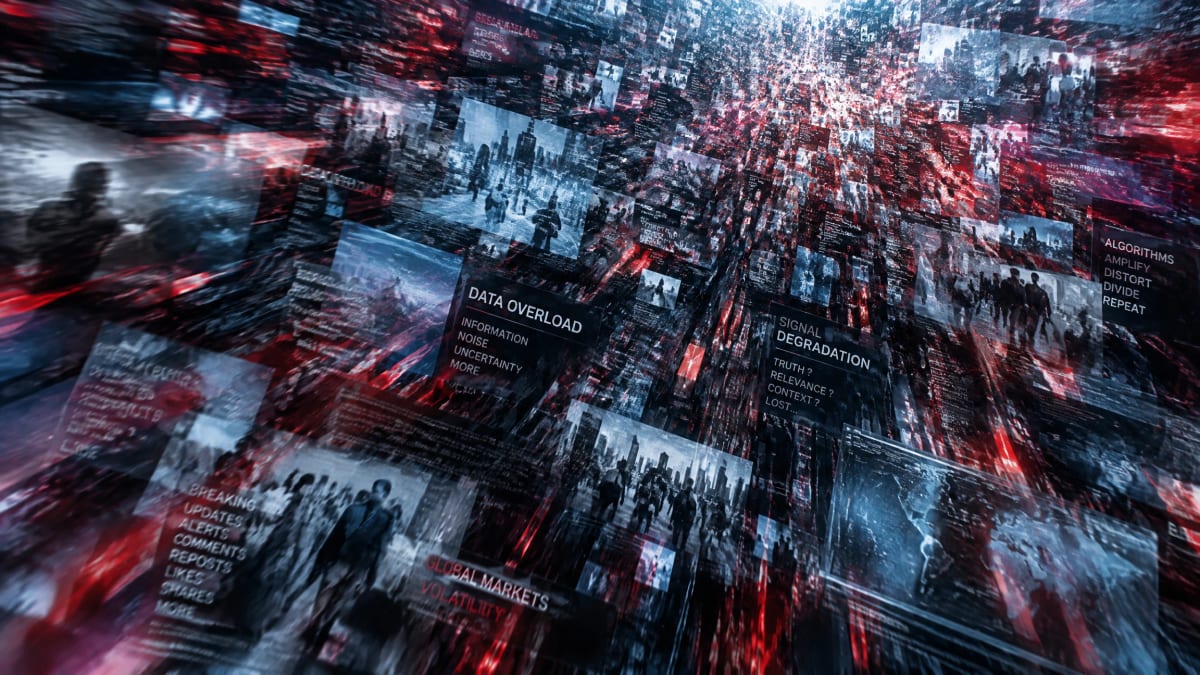
No time to judge, even when the source is right there
Picture scrolling through social media and watching 10 videos. Now picture verifying all 10. Where would that time come from?
This is what I keep coming back to: in the era of mass information, you really only have three options.
- You accept the sources and trust their honesty.
- You put in the effort to verify them yourself, whatever that costs.
- You let yourself be manipulated, willingly or unwillingly.
Most of the time, most of us pick option one, and call it common sense. It isn’t really a decision. It’s a default.
And here’s the uncomfortable admission from my side. I can’t give you a neat story about the one video that fooled me, or the day I caught myself believing a false AI answer and then found out. I’ve thought about it, and I don’t have that example. What I do have is a pattern, and I think the pattern is more honest than a tidy anecdote would be.
The two ways I meet AI answers
When AI tells me something I already know, I can spot the errors easily. I’ve experienced that many times. Hallucinations in my own areas stand out like a wrong note in a familiar song.
When AI tells me something I don’t know, I have no way of telling whether it’s right or wrong. None. What I have is my intuition about whether it sounds right, and my willingness to accept it. And “sounds right” is exactly the thing a language model is best at producing.
Think about what that means. My ability to catch AI errors is strongest exactly where I need it least (topics I know), and weakest where I need it most (topics I don’t). The gap between those two is where manipulation lives.
I see small versions of this all the time when I use the free Google AI answers on search results. Sometimes the hallucination is obvious. Sometimes it isn’t. If you are curious enough to double-check, or you interact with the AI and push back, you realize the answer was wrong. But you have to be curious enough. That’s the catch: the check is optional, and the answer is already sitting there, tidy and fluent, at the top of the page.
Why language is the perfect weapon
Here is the core idea of this article, and it’s the one I wrote down before I wrote anything else: AI is a great language manipulator. It can misdirect anyone who is not aware, or not willing to verify.
Notice I said “language.” A model doesn’t need to be malicious to mislead you. It just needs to be fluent. Fluency reads as competence to the human brain. A confident paragraph with good structure feels more true than a hesitant one, regardless of what’s inside.
Now stack that on top of a hungry, hurried audience. Someone who wants the answer in five seconds, who has fifteen more things waiting in the queue, and who has a sense of already knowing it all. You don’t have to lie to that person cleverly. You just have to be fast, smooth, and plausible.
The YouTube tips that don’t work
I’ve seen plenty of YouTube videos, especially cooking-related and tip-related ones, that are purely AI-generated. Many are hallucinations of things that don’t hold true in real life. They’re scientifically false, or flat-out impossible to do.
The tricky part is that they can seem perfectly reasonable while you watch. Good pacing, calm narration, a confident method. Nothing in the video itself gives it away.
What gives it away is usually the comments. If you read them, you can find people pointing out the video is AI-generated, and others disproving it with scientific reasons why it wouldn’t work, or health reasons why you shouldn’t try it. (I’m keeping this general on purpose; the specific video isn’t the point. The pattern is.)
But how many people read the comments? Not many. And even if you do, you’ll often find contradicting arguments down there, which opens up a different rabbit hole. Verification has its own rabbit holes.
Views as a trust signal
There’s one more mechanism, and it’s the one we can do the least about. We give trust based on the number of views and comments. A video with a huge view count gets more value and importance from us by pure instinct, and we may treat it as a trustworthy source.
But views are the output of an algorithm, not a fact-check. High views tell you the video was good at holding attention. They tell you nothing about whether it’s real or true. There is nothing you can do to prevent this; it’s the algorithm’s work. All you can do is know that it’s happening.
”Real or AI?” is becoming a question with no answer
My own filter is decent right now. I can identify roughly 90% to 95% of AI videos. That comes from years of staring at footage, a lot of it (10,000+ hours of editing will train your eye whether you like it or not).
But that number will not hold. The models are improving week by week. There will be a time when identifying AI video is simply impossible, even for someone who does this for a living. And I’m the guy for whom this instinct is second nature. Imagine what that looks like for someone who has never edited a frame.
So the “is this real?” reflex, on its own, is not going to save us. It’s necessary but not sufficient. The reflex only works if there’s something behind it, meaning the willingness to act on the doubt.
And that’s where I keep landing.
Convenience beats the willingness to know what's real.
That’s the whole problem in one sentence. It’s not that the truth is hidden. It’s that checking is expensive, and accepting is free.
What a “basic ground check” actually looks like
I don’t want to leave you with just a diagnosis, so here’s what I actually do. It isn’t fancy, and it isn’t a system. It’s a habit.
Take everything with a grain of salt. That’s the baseline. Not cynicism, just a default of “maybe.”
If you’re going to put an idea to the test, or use it in an argument, do at least a basic ground check. That means widening the search to verify from more than one source. Read related articles, not just the one that landed in front of you.
If it matters, go deeper. Health and science claims deserve a thorough verification of the sources and where the information originally came from. Not the video that summarized the article that summarized the study. The origin.
Ask a human who knows. Depending on the subject, I ask other people with knowledge in the field for their opinion. It’s the oldest verification method there is, and it’s still the one AI can’t fake.
For the friend who only has five seconds per video: you can’t check everything, so don’t pretend to. Hold most things loosely. Save your real effort for the claims you’re about to act on, share, or build an opinion on. The goal isn’t to verify all ten videos. It’s to notice which one deserves a second look.
What we stand to lose
If this goes the way it’s heading, I think what people lose first is their critical thinking, and eventually, their freedom.
I’d flip that around too. If you want to understand how we got here, a lack of critical thinking is a cause of the situation, not only a result of it. A population that doesn’t question what it’s fed is easy to steer, whether by an advertiser, a government, a content farm, or a model that’s simply good at sounding right.
Of all the tools a person can have, critical thinking might be the most essential, and the reason is that it’s internal. You can’t control the algorithm. You can’t control how good the fakes get. You can’t control what the power holders choose to disclose. But you control how you evaluate what reaches you.
Critical thinking is your evaluation guardrail. Without it, you are susceptible to anything that comes your way.
If people aren’t willing to analyze what they’re being fed from a logical point of view, they leave themselves exposed to mass manipulation and misinformation. That’s not a technology problem. Technology just makes the exposure bigger.
A question I can’t fully answer
I don’t have a clean ending for this one, and I’d rather be honest about that than tie a bow on it.
What I do know is this. AI isn’t going to slow down, the feeds aren’t going to get less hungry, and our time isn’t going to expand. The only variable left is us: whether we are aware, and whether we are willing.
So here’s what I’m asking myself, and I’ll leave it with you. The next time a video or an answer feels right and you’re about to let it slide, what is the smallest possible check you could do? Not a full investigation. Just one extra source, one comment thread, one person who knows.
Because if convenience keeps winning, then sooner or later someone (or something) will be deciding what we know. And they won’t need to lie very well.
Do you check? Be honest. I’m still working on it too.