

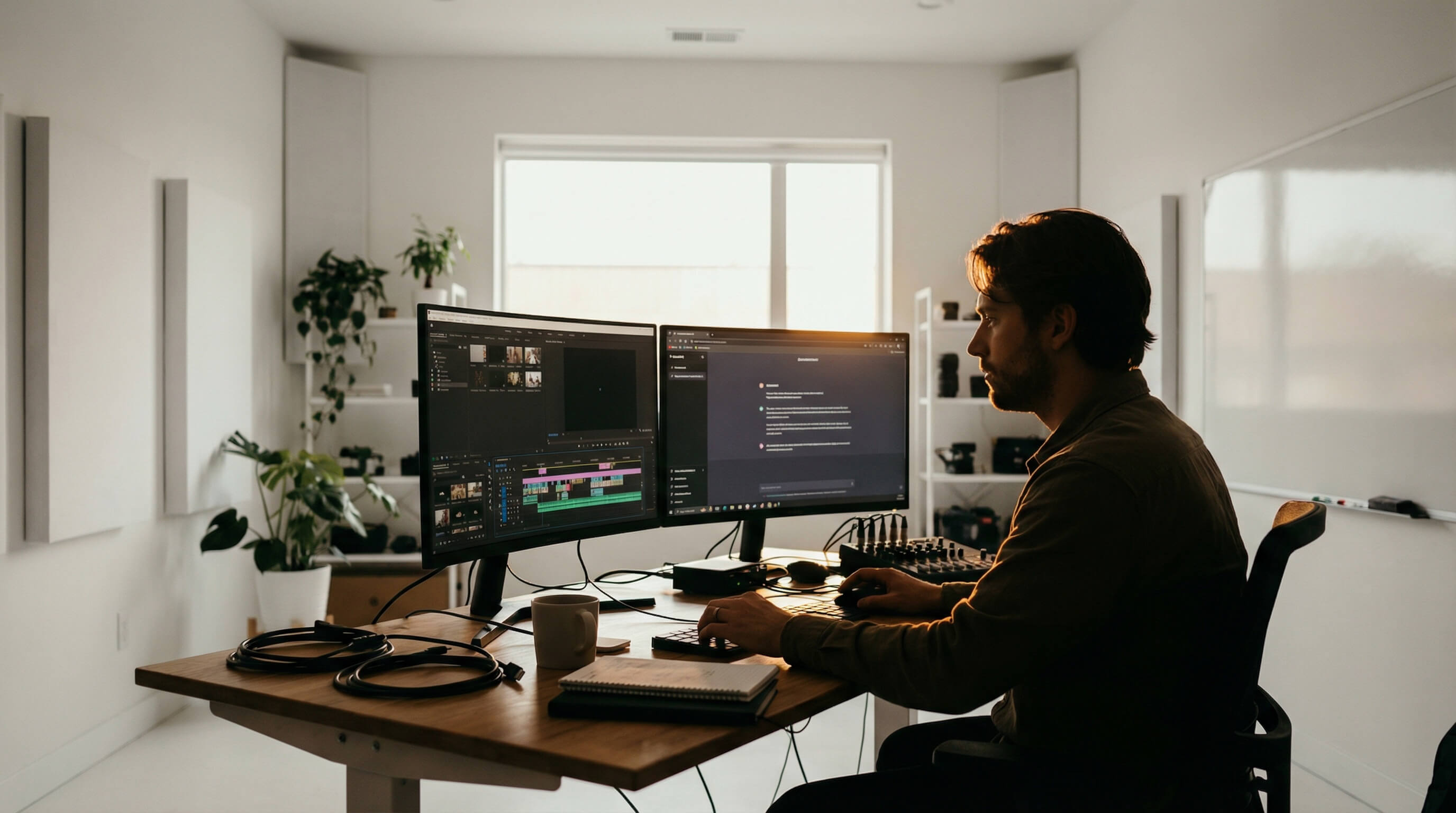
Sundance 2026 just wrapped, and something happened there that would have been unthinkable three years ago.
Multiple production-ready short films premiered using AI-generated footage. Not as a gimmick. Not as an experiment. As actual, watchable, emotionally resonant films that held their own against traditionally produced work.
The “jitter problem”, that uncanny, unstable quality that made AI-generated video unusable for serious production has been solved to a large extent. Kling 3.0 and Runway Gen-4.5 can now produce footage with the temporal consistency that professional work demands.
But here’s what interested me more than the technology: who made these films?
Not studios and not production companies with fifty employees and millions of budget. Individual creators. People working alone, often without traditional film school backgrounds, producing work that looks like it cost hundreds of thousands of dollars.
We’re watching a new category of filmmaker emerge. And after nineteen years producing videos and recently building TAGiT - my AI-powered video learning tool - I think I understand what’s happening.
The “AI Filmmaker” Is Real Now
The term gets thrown around loosely, but there’s now a real, definable category: creators who see themselves not as traditional directors but as creative directors guiding AI systems.
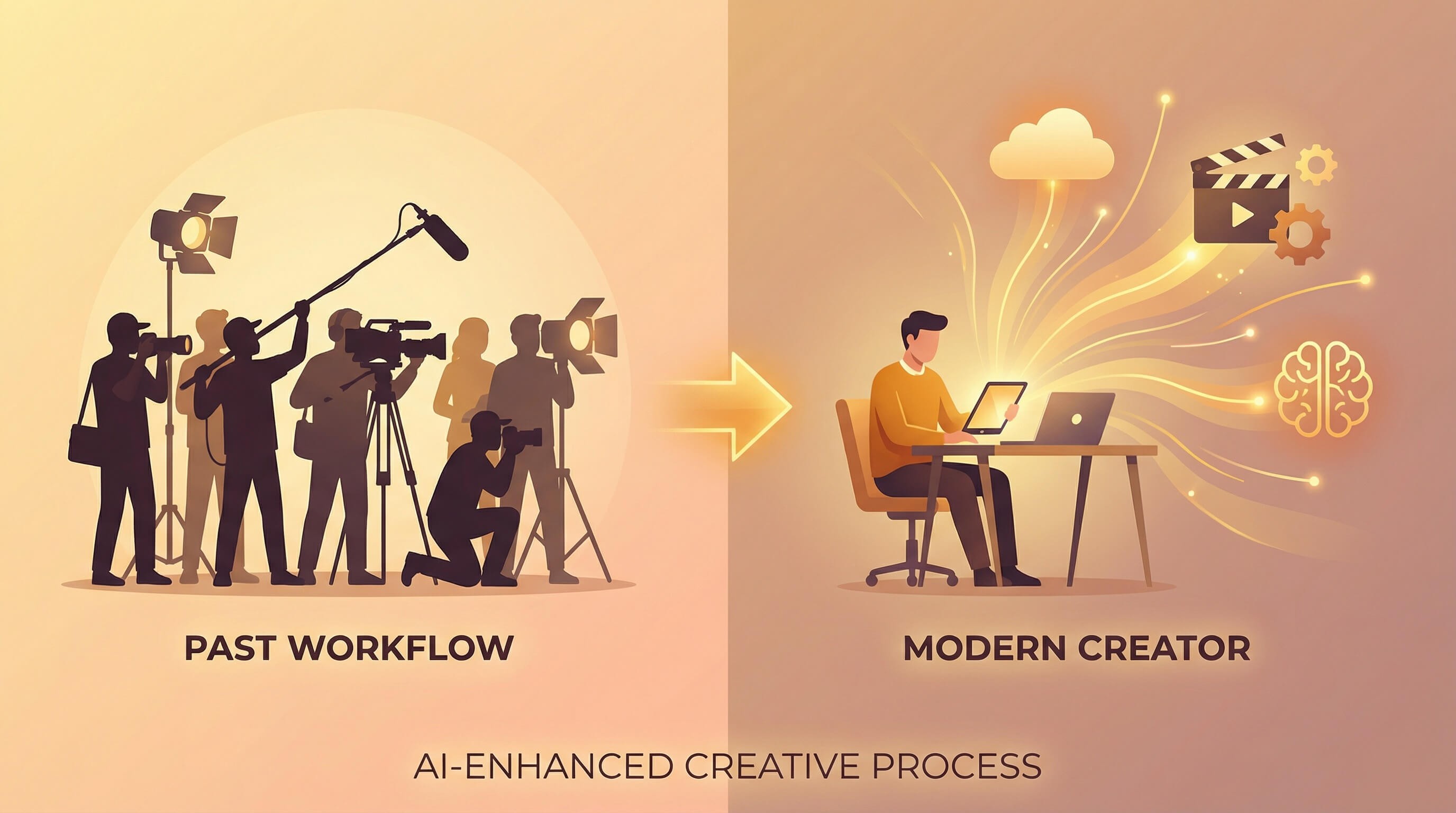
These aren’t people who replaced filmmaking with AI. They’re people who couldn’t have made films at all without it. The barriers that kept them out, like equipment costs, crew requirements, post-production expertise, VFX budgets, have collapsed.
According to industry analysis, solo creators are now producing 20-minute films with production values that rival professional studios. In under a month. Working alone.
That’s not incremental progress. That’s a structural change.
What Actually Changed
I’ve been in video production for two decades. The tools have always been getting better. So what’s different now?
The jitter problem is solved. This was the blocker. Previous AI video tools produced footage that looked unstable, dreamlike in the wrong way, unusable for anything that needed to feel grounded. According to technical analysis from AI FILMS Studio, the integration of neural radiance fields (NeRFs) and Gaussian splatting within video diffusion models fixed this. These systems now understand spatial relationships, object permanence, and physical constraints, not just statistical patterns.
The tools specialize. There’s no single platform that does everything well. But the ecosystem now works. Kling 3.0 excels at natural human movement and realistic motion. Sora 2 handles narrative coherence and photorealism. Runway Gen-4.5 offers precision control for iterative work. Veo 3.1 brings cinematic camera work. The skill is knowing which tool for which shot.
The cost equation flipped. AI video generation market hit $946 million in 2026, up from $788 million last year. Growth is 20% annually. That investment is driving down costs while driving up quality. Generations that took minutes now take seconds. What cost hundreds per minute of footage now costs dollars.
Audio caught up. The weak link was always sound. AI-generated video with stock music and robotic voiceovers wasn’t fooling anyone. ElevenLabs and similar tools have gotten genuinely good at synthetic speech. Natural inflection, multiple voices, reasonable pacing. Still requires work, but the gap closed.
What This Actually Looks Like In Practice
I’ve been experimenting with AI video tools for my work, though most of what I do still relies on real footage or at least a mixture. Here’s what the workflow actually looks like for someone going full AI:
Pre-production takes longer, not shorter. The better your brief, the better your output. This is where traditional filmmaking discipline pays off. Storyboards matter more, not less. Shot lists matter more. You’re not pointing a camera and reacting - you’re describing what you want precisely enough for a system to generate it.
Generation is iterative. You’re not getting a finished shot from a single prompt. You’re generating ten, twenty, fifty variations looking for the five that work. Adjusting parameters. Learning what the system responds to. It’s more like directing a visual effects team than directing actors.
Post-production is assembly. Each generated clip is a starting point, not an end point. You’re combining AI-generated footage with real footage, with still images from Midjourney or Flux or other tools, with audio from ElevenLabs or similar. The editing is where the actual filmmaking happens.
Polish takes time. Color grading for consistency across generated clips. Timing adjustments to match audio. Upscaling. Quality checks. The AI generates raw material. You shape it into something watchable.
This process, done well, still takes weeks for a complex project. The people who claim they’re making films in days are either working at a scale I don’t understand or they have a different definition of “film” than I do.
The Economics Have Actually Changed
Y Combinator reports that the average time to MVP for their W24 batch decreased by 60% compared to 2022. Menlo Ventures found that AI-native startups reach product-market fit 2.4x faster than traditional software companies.
These stats are about software, but the same dynamic applies to content creation. The fixed costs that used to gate high-quality production, crew, equipment, location, post-production expertise, are now variable costs that can be reduced to nearly zero for certain types of projects.
This doesn’t mean professional production is dead. If you’re considering traditional production, knowing what separates video production from videography still matters. It means the competitive landscape has changed. A solo creator with taste and persistence can now produce work that competes visually with professional productions. Not always. Not on every dimension. But often enough to matter.
When I built TAGiT, I discovered something similar. AI tools let me, as a non-developer, build a production-ready SaaS product with thousand lines of code. I still needed to understand what I was building. I still needed taste, judgment, persistence. But the technical execution barrier collapsed.
The same thing is happening in filmmaking.
What This Means For Traditional Filmmakers
If you’re a filmmaker with real experience, you’re not obsolete. You’re potentially more valuable.
Here’s why: AI tools are incredibly powerful and incredibly generic. They produce output that follows patterns from training data. They don’t understand why a particular shot works emotionally. They don’t know when to break conventions for effect. They don’t have a perspective.
Your decades of experience in visual storytelling - understanding pacing, knowing when a cut feels right, sensing what an audience needs to feel at a particular moment - that’s harder to replace than technical execution.
The new model looks less like “AI replaces filmmaker” and more like “filmmaker becomes creative director of AI systems.” You’re not operating the camera. You’re not spending hours in color grading software. But you’re still the one making creative decisions about story, emotion, and meaning.
That’s not a smaller role. It might be a bigger one.
The Skills That Matter Now
Based on what I’m seeing, here are the skills that matter most for this new type of filmmaking:
Prompt craft. The ability to describe what you want precisely enough for AI systems to generate it. This is a learnable skill, but it takes practice. You need to understand what the tools respond to and how to communicate visual intent through text.
Taste and judgment. When you’re generating fifty variations of a shot, you need to know which are actually good. This comes from experience watching and making films. It can’t be prompted.
System thinking. Understanding how different tools work together. Knowing that Kling handles motion well but struggles with fine detail. Knowing when to use AI generation versus shooting real footage. Knowing how to composite multiple sources into something coherent.
Narrative understanding. AI can generate impressive individual shots. It cannot tell a story. The structure, pacing, emotional arc - that’s still entirely human. Maybe more important than ever, because the visual execution is no longer the hard part.
Persistence. The tools are powerful but finicky. You will generate garbage before you generate gold. You will hit walls and have to work around them. The creators who succeed are the ones who keep iterating.
What I’m Doing About This
I’m not abandoning real cameras. Filmmaking still relies on capturing real people in real situations. That’s the point. Especially if we are talking about event coverage, there is no other way round it. For clients who need on-location capture — conferences, interviews, brand films shot in Greece — I still work as a videographer in Athens with the full crew and broadcast-grade gear that AI can’t replicate.
But I am integrating AI tools more deeply into specific parts of my workflow:
Concept development. When I’m exploring visual approaches for a project, I generate variations quickly. This lets me test ideas before committing to expensive production.
B-roll and transitional footage. Not every shot in a documentary needs to be real. Establishing shots, historical recreations, abstract visualizations, these can be AI-generated without compromising authenticity.
Educational content. For Ancient Greece Revisited, the history channel I co-created with Michael Michailidis, AI-generated imagery can visualize things we could never shoot. Ancient cities as they might have looked. Historical events reconstructed.
Experimentation. I’m setting aside time specifically to learn these tools deeply. Not for immediate client work, but for building capability. The learning curve is steep but the tools are evolving fast.
The Assessment
Is AI going to replace filmmakers? Some, yes. The ones who were primarily technical operators rather than creative thinkers. The ones who offered execution without vision.
Is AI going to replace filmmaking? Probably not. Stories still need to be conceived. Emotions still need to be orchestrated. Meaning still needs to be constructed. The medium through which these things happen is changing, but the fundamental creative work remains human.
The solo AI filmmaker is real. They’re producing impressive work. And they’re only going to get better as the tools improve.
But here’s what I keep reminding myself: being first to adopt a tool is less important than being good at using it. The filmmakers who will matter aren’t necessarily the ones who jumped on AI earliest. They’re the ones who combine the new tools with genuine creative vision.
That’s always been true in this industry. It still is.
Are you experimenting with AI video tools in your work? I’m curious what’s working and what isn’t. Reach out via the contact page - I’m genuinely interested in what other creators are discovering.
Sources: