

The Real Cost of AI Video Production
In March 2023, a video went viral for all the wrong reasons. Someone had fed a text prompt into an early AI video model and asked it to show Will Smith eating spaghetti. What came back was a spaghetti output on its own: a morphing face, hands with extra joints in unexpected places, and pasta that appeared to be sentient. The whole internet laughed. Including me.
Two years later, Google’s Veo 3 recreated the same scene with such accuracy that seasoned editors struggled to identify it as AI. Same prompt, roughly. Completely different world.
That’s the trajectory of AI video. And understanding it, not just marveling at it but actually understanding what it can and can’t do for real productions, is what led me to build something I’d been needing for a while: an AI video production cost calculator.
How We Got Here: Three Years of Surprises
Before getting into cost specifics, it’s worth tracing the arc. Because where this technology came from matters for understanding where it actually stands now.
2023: Images Stunned Everyone, Video Was a Mess
When Midjourney made its entry in 2022-2023, it felt like a genuine shock to the system. I’ve been making visual content for over 20 years, and at that moment I had to stop and reckon with what was suddenly possible. You could describe a scene in words and get back something cinematic, textured, and genuinely beautiful. Not always. Not on command. But often enough to be unsettling. A new world of possibilities had just been born.
Video was a completely different story. The models that existed in early 2023 produced results that were more uncanny than useful. The Will Smith spaghetti video, created in March 2023 using a tool called ModelScope, became a kind of cultural shorthand for everything that was wrong with AI video at the time: the unnatural movement, the morphing faces, the sense that something fundamental about physics and time was being violated. It was funny, but it was also honest. That’s what the technology could do.
Image generation got better fast. By late 2023, AI images were regularly indistinguishable from photographs, at least in controlled conditions. Hands, which were famously broken for a long time, finally started working. The gap between what you imagined and what appeared on screen narrowed considerably.
2024: Video Takes a Real Leap
The big moment came in February 2024, when OpenAI unveiled Sora. It almost feels like yesterday, and i remember i was utterly shocked and alarmed back then. The demonstration videos were a level above anything we’d seen. Longer shots, coherent motion, camera work that looked intentional. It wasn’t perfect. There were still artifacts if you looked closely, and temporal consistency, keeping objects and people looking the same throughout a shot, remained a genuine challenge. But the direction was unmistakable.
Runway continued refining its Gen series. Kling launched from Kuaishou in mid-2024 and quickly established itself as a serious contender, particularly for the price-to-quality ratio. Google’s DeepMind team, Pika, and others were all pushing the frontier simultaneously.
For the first time, I started exploring AI video solutions as a production option, not just a novelty.
2025-2026: Impressive, But Complicated
The current generation of models, Runway Gen-4.5, Google Veo 3.1, Kling 3.0 and its variants, can produce footage that’s genuinely hard to identify under the right conditions. Ironically OpenAI that shocked the industry with Sora, decided a few days ago to drop their model entirely. But the race between the other competitors is as intense as ever.
Physics simulation has improved dramatically. Water moves correctly. Fabric has weight. Camera movements feel considered rather than random. Platforms are now integrating audio-visual generation natively, and workflows are being offered as a one click implementation.
The adoption numbers reflect the shift. AI video production has reportedly grown over 800% in volume between 2024 and 2026. Practically every major production workflow now has some AI component. The market is consolidating around a few serious players who are investing heavily in consistency and control.
And yet. Here’s the part that often gets left out of the enthusiast coverage.
The Filmmaking Rules Still Apply
Anyone can open Runway or Kling right now, type a prompt, and generate something. Most of what gets generated this way is generic, poorly motivated visually, or inconsistent shot to shot. Not because the models are bad. Because generating a good video still requires filmmaking knowledge.
You still need to think about:
Shot composition: What’s in frame, where, and why? A prompt that says “man walking down a street” will give you exactly that. If you want atmosphere and intention, you need to direct it more precisely.
Camera movement: Does that pan serve the story or is it just motion for its own sake? The models will give you movement if you ask for it. Whether that movement means something is your job.
Continuity: How does this shot connect to the one before and after it? AI currently struggles with subject consistency across separate generations. Multi-shot productions require specific workflows, often building from reference images rather than generating from text alone.
Tone and pacing: What is the emotional register of this scene? “Cinematic” isn’t enough. What kind of cinematic?
I’ve been on sets since my father, George Petritsis, a respected documentarist, first brought me along as a kid. I’ve spent two decades thinking about these questions for real documentary and corporate productions. When I started working seriously with AI video, I quickly found that the filmmaking instincts I’d built up were more valuable than ever. They just had to be applied to a different kind of directing.
The models have gotten good enough that they’re no longer the weakest link in many productions. The weakest link is often the brief, the creative direction, or the lack of understanding about how to build a coherent visual story across multiple generated shots.
Why I Built a Cost Calculator
Clients and more importantly potential clients always have the same question in mind before even reaching out: “How much will video production cost?”
My honest answer is: “It depends on things you probably haven’t thought about yet and your overall vision for the project.”
One thing is certain. You can’t estimate a video production cost if you haven’t talked to the client first. But for AI video, where the environment is more controlled and no filming needs to take place (in some cases you may still need to), a cost estimate can be calculated and be close to reality.
The variables are real. Which model are you using? How many shots does the production need? Are you working image-to-video (higher control, more prep work) or text-to-video (faster, but harder to keep consistent)? How many generation attempts does it typically take to get a usable shot? What’s the post-production overhead? Do you need music, voice work, color grading?
I started tracking my own production data across projects. Generation attempts per shot, time per usable output, credit costs across different models, post-production hours. After several months, patterns emerged that I could actually work with.
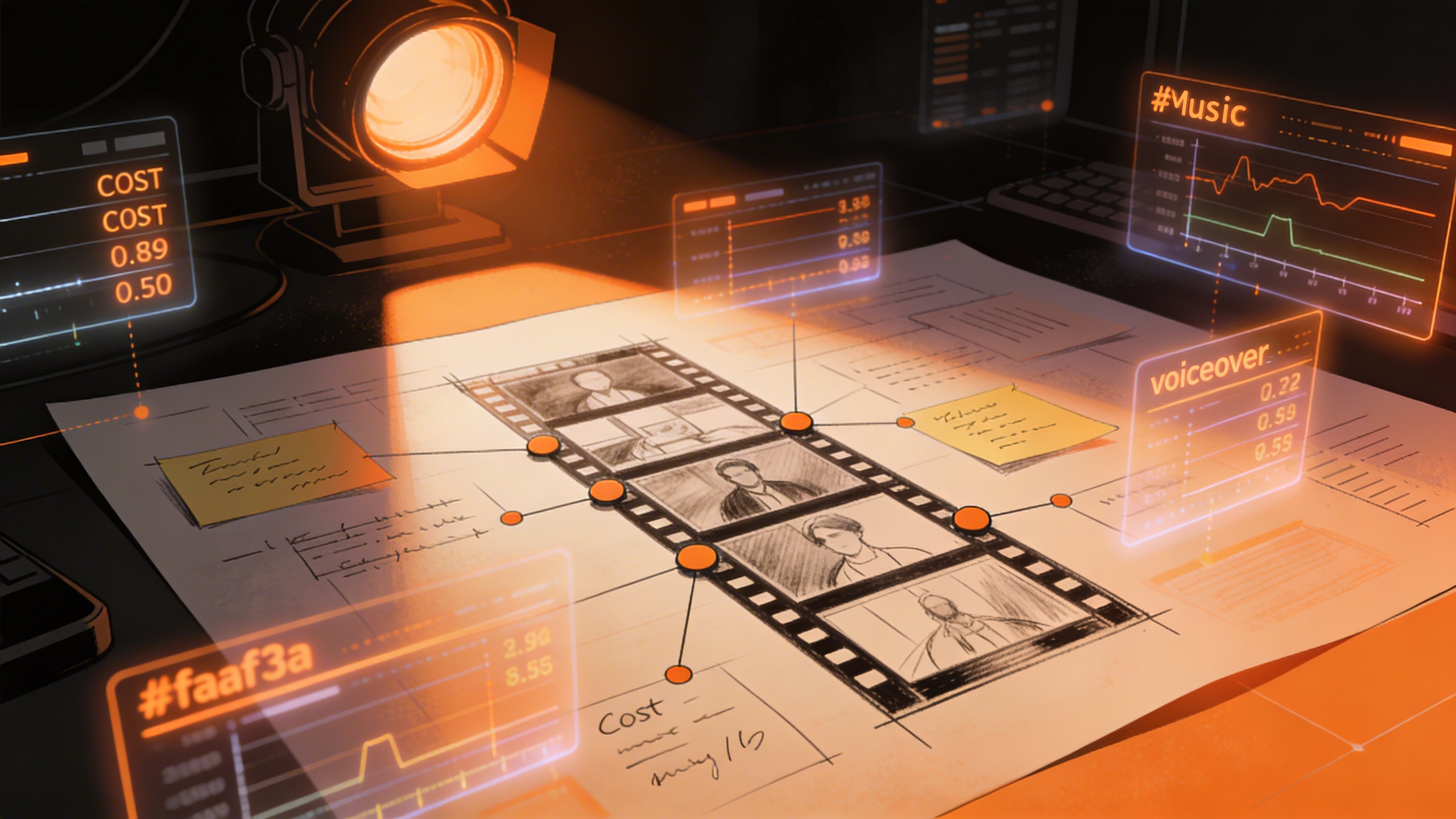
The calculator I built takes a client’s input choices and breaks it down into components: number of shots, estimated attempts per shot based on complexity, model selection, post-production time, and any additional elements like music or voice. It produces a cost range with low and high estimates.
Is it perfect? No. AI video production is still unpredictable enough that any estimate carries meaningful variance. But it sets the baseline for a meaningful conversation. It stops the “can you do this for 200 euros?” asks when the realistic budget is five or ten times that. It also helps me identify when AI is genuinely the right tool versus when traditional production methods make more sense.
What the Numbers Actually Look Like
For a typical 60-second branded commercial video with 10-15 shots, working in 2026:
- Budget tier (moderate post-production): roughly €400-800
- Professional tier (multi-model workflow, more iteration, full post-production): €1,200-1,600
- Premium tier (pre-production, concept development, multi-model workflow, heavy iteration, full post-production): €2,000+
Compare that to traditional video production for the same brief: typically €3,000-15,000 depending on scope, location, and crew. The savings are real and significant for the right projects. But they’re not free. And they’re not “just type a prompt and get a video.”
Anyone quoting you €100 for a polished AI production video either doesn’t understand what’s involved or is planning to send you something you won’t want to use.
Where This Leaves Us
AI still doesn’t replace traditional production. Cameras, real light, and the energy of working on a set are still there. There’s something that happens on location that no model can replicate, and for certain projects, it shouldn’t even try (yet).
But when a potential client has a real story to tell and a limited budget, AI-assisted production can make that story possible when it otherwise wouldn’t be. That has real value. The cost calculator helps me communicate that value clearly, and it helps clients arrive at the conversation with realistic expectations on both sides.
The technology will keep improving. Subject consistency across scenes, which was genuinely difficult a year ago, is now manageable with the right workflow. The gap between what you can imagine and what you can generate is narrowing every few months.
The filmmaking fundamentals, though, aren’t going anywhere. If anything, they matter more now. Because the floor has dropped out from under the technical barriers, and what’s left is your taste and whether you actually know what you want to say and do.
So, go ahead and try it, it’s quick and free and it will answer your first question before you ask it!